
Garage Epoxy Products Explained for Boise, Eagle and Meridian: 100% Solids, Water-Based Kits, Flake and Polyaspartic Topcoats
Garage floor quotes in Boise, Eagle and Meridian are full of product names: 100% solids, water-based, polyurea base, polyaspartic topcoat, full flake broadcast, moisture-mitigating primer. The names matter, because two quotes that both say "epoxy floor" can describe very different amounts of material on the slab. This guide explains what each product is and how to read the line items so you are comparing the same floor. For epoxy versus polyaspartic as whole systems, read the comparison post.
Boise Garage Floor Epoxy is a free quote service. The independent local coating companies that reply to your request inspect the slab, write the quote and do the work.
The three tiers of "epoxy"
Almost everything sold for a garage floor falls into one of three tiers, and the price gap comes down to how much cured material ends up on the concrete.
1-part kits. These are really epoxy-modified or acrylic floor paints: easy to roll on, thin, and the least durable option. Some include no topcoat at all.
2-part water-based kits. A true two-component epoxy you mix before rolling, with better adhesion and hardness than a 1-part product, but most are water-based with low solids, so the cured film is still thin. Big-box kits in Boise and Meridian stores run roughly $120–$450 in materials for a two-car garage, usually with a packet of flakes for a light sprinkle.
100%-solids epoxy and polyaspartic systems. This is what professional installers use. A 100%-solids epoxy leaves all of its volume on the floor as cured film, bonds very well to properly ground concrete and builds thickness quickly. Multi-part 100%-solids or polyaspartic kits sold to DIYers can run $1,000 or more in materials before grinder rental, crack filler and flake. The post on DIY kits vs. professional installation covers when the kit route makes sense.
Solids content is the share of a product that stays behind after it cures. Water or solvent carries the resin onto the floor and then leaves, so a low-solids product dries to a much thinner film than the wet coat suggests. That is also why thicker, high-solids products cover fewer square feet per gallon: they leave more material on the floor. On a quote, the useful question is what thickness each coat goes on at, not how many coats there are.
Base coats: epoxy, polyurea or a moisture primer
The base coat is the pigmented layer that bonds to the concrete, and on a Treasure Valley quote it is one of three things. A 100%-solids epoxy base gives a thick, strong build at a lower cost with a long working time. A polyurea base cures fast and goes directly on ground concrete with no epoxy primer; it is what makes a one-visit polyaspartic floor possible. A moisture-mitigating epoxy primer goes under either when the slab shows moisture vapor. Whichever appears on your quote, it should be going onto diamond-ground concrete; a base coat over etched or merely cleaned concrete is where peeling under hot tires starts.
Flake: what "full broadcast" means
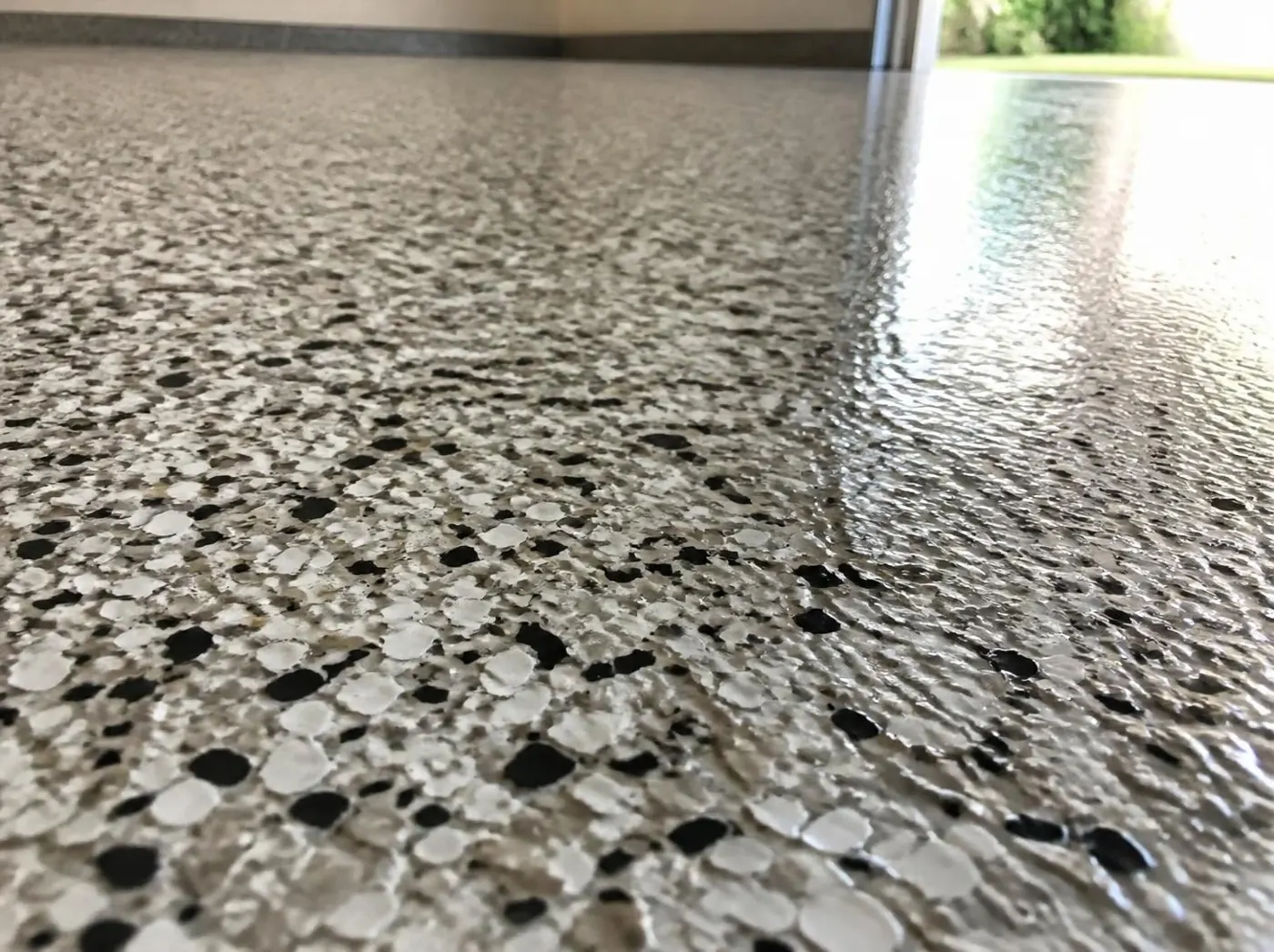
A flake, or chip, floor is a colored base coat with vinyl color flakes broadcast into it until the surface is fully covered, then scraped and sealed with a clear topcoat. It is the most popular garage floor in Boise, Meridian and Eagle because it balances looks, grip and price. The product detail that matters is coverage. A full broadcast, sometimes written as broadcast to rejection, means chips are thrown until the wet base coat cannot hold any more; a light sprinkle, which is what most kits include, leaves most of the base coat exposed. Full broadcast adds thickness and texture and hides dust and tire marks.
Flake size and blend are style choices: quarter-inch chips give the classic speckled look, smaller chips read as a finer texture, and grays and blacks with a touch of white are the most forgiving. The flake epoxy garage floors page shows how the system goes together.
Topcoats: polyaspartic, polyurethane or plain epoxy
The clear topcoat takes the wear, the sun and the hot tires, so it is the product name worth paying most attention to. A polyaspartic topcoat is an aliphatic polyurea: UV-stable, so it will not amber near a west- or south-facing door, hard and chemical-resistant against oil, antifreeze and winter deicers, and quick to return to service. A polyurethane topcoat is another UV-stable option. A plain epoxy topcoat is the lowest-cost choice and can be fine in a garage with little direct sun, but standard epoxy is not color-stable in sunlight. If a quote lists two coats of epoxy and nothing else, ask what protects the area just inside the door.
Two add-ons live in the topcoat: an anti-slip additive, a fine aggregate mixed in for grip where snowmelt drips off vehicles, and a satin finish instead of high gloss, which can reduce slickness. The post on hot tire pickup and UV yellowing explains why the topcoat choice shows up first in Boise summers.
Reading the product names against the price
Typical installed ranges in the Treasure Valley line up with the product tiers: about $3–$6 per square foot for solid-color epoxy (grind, two coats, topcoat), $4.50–$8 for full-broadcast flake epoxy, $5.50–$10 for polyaspartic or polyurea flake systems, and $7–$12 for metallic epoxy, a mica-pigmented 100%-solids epoxy that needs a smoother substrate and more skilled application. Heavy crack or spall repair, old coating removal and moisture mitigation typically add $1–$3 per square foot. A typical two-car garage of 400–480 square feet lands around $2,000–$4,000 for a flake floor. These are typical ranges, not quotes. The garage floor epoxy cost guide has the full table and a calculator.
When a quote comes in well under the range for its tier, the product list usually explains it: a water-based base coat, a light flake sprinkle, no UV-stable topcoat, or acid etching in place of grinding. When it comes in high, look for a thicker topcoat, stem-wall coat-up, a moisture primer or repairs another installer left out. Older garages in the Boise Bench and North End often need old paint or sealer ground off before any of these products will bond, while new slabs in Meridian and Eagle subdivisions usually carry a builder curing compound that comes off the same way. The Boise, Eagle and Meridian pages cover what local slabs tend to need.
Frequently asked questions
What is the difference between 100% solids epoxy and a water-based epoxy kit?
Solids content is the share of the product that stays on the floor after it cures. A 100%-solids epoxy leaves everything it is rolled on as cured film, so it builds real thickness. Most big-box two-part kits are water-based with low solids, so the cured film is thin even though it is a true epoxy, and thin films are what hot tires soften and lift.
Is polyaspartic the same as polyurea?
Polyaspartic is a type of polyurea formulated for a workable application time on floors, which is why the two names get used interchangeably in Boise marketing. A polyurea base coat and a polyaspartic topcoat belong to the same family. Ask what thickness each coat goes on at and whether the topcoat is UV-stable rather than relying on the name.
What does a full flake broadcast mean on a quote?
A full broadcast, sometimes written as broadcast to rejection, means color chips are thrown into the wet base coat until the surface cannot hold any more, then scraped and sealed with a clear topcoat. A light sprinkle uses far less flake and leaves most of the base coat exposed. Full broadcast adds thickness, texture and grip and hides dust and tire marks.
How much do the different garage epoxy products cost installed in Boise?
Typical installed ranges in the Treasure Valley are about $3 to $6 per square foot for solid-color epoxy, $4.50 to $8 for full-broadcast flake epoxy, $5.50 to $10 for polyaspartic or polyurea flake systems and $7 to $12 for metallic epoxy, plus $1 to $3 for heavy repair or moisture mitigation. Big-box kits run roughly $120 to $450 in materials for a two-car garage. These are ranges, not quotes.
Next step
To see the products spelled out for your own slab, request a free on-site quote. Independent local companies reply directly and give you a written quote that names the base coat, the flake coverage and the topcoat so you can compare line by line.